The LitLair

The LitLair: A Sanctuary for Dreams Told and Visions Shared

Tag: fiction

  • The Blood of Witches

    Disclaimer: This story was originally written by Evonne Smith and subsequently edited with the assistance of Perplexity AI to enhance clarity and readability. All content within this story remains the sole property of Evonne Smith. Any reproduction, adaptation, or use of this material without prior written permission from Evonne Smith is strictly prohibited.

    Prologue: The House of Eternal Suspicion

    The house is never silent. Its timbers groan beneath the weight of centuries, every sound a whispered accusation. Night after night, Evie writes beneath the ceaseless gaze of judgment, her lamplight barely holding back the shadows. Each letter to her brother, Donald, is a plea and a record—a chronicle of suffering, suspicion, and the cycle of power and pain that binds this place.

    Part One: The Cage

    Chapter 1: The Quiet Prison

    All houses bear witness, but this house in its very timber, beneath its gabled roof, pronounces judgment. Its creaks are whispered accusations. Its walls, stained by old candle smoke and fingers pressed in fear, stand as mute jurors and stern confessors.

    Evie listens for Ryker’s footsteps as someone condemned waits for their judge. Her world narrows to the rhythm of those boots on warped boards, each sharp click a verdict. His temper dictates her weather. His silence is her sentence.

    She kneels at her desk, parchment sheltered in the flicker of a single candle. The pen scratches a desperate testimony—each word an item of evidence in the trial of her life.

    To Donald,

    Brother, ghost and confessor in dream, I write not as accuser but as the condemned. I mark each day by submission, each sunrise by the chains of patience. The law of this house brooks no dissent. The shadow of the inquisitor lengthens with every hour.

    Evie glances at the door. Shadows ripple under the sill, expecting her secrets. She folds the letter quickly, tucking it into the hollow spot beneath the floorboards—her secret reliquary of sorrow and hope.

    In this house, even the air is wary. Evie has learned that survival means silence, shrinking her presence until nothing remains to provoke judgment. She remembers too well the lessons of obedience drilled by their father, the architect of invisible suffering, whose shadow persists in Ryker’s every word.

    She rises as dawn ghosts the windowpane, keeping herself small to pass beneath Ryker’s notice. The kitchen becomes court and gallows, every meal prepared with careful ritual.

    Ryker enters, his eyes cold and weighing her. His glance searches for evidence, his voice brings the sentence.

    “You’re up early,” he says, suspicion twisting his features. “What’re you hiding?”

    Evie bows her head. “Only breakfast, Ryker. You said you needed to leave before first light.”

    His expression sharpens. “You’re trembling. Scheming, or just clumsy?”

    She steadies herself. “Neither. Only tired.”

    He circles her, predatory. The tension in the room is thick, each word dangerous.

    “The pantry’s missing flour,” he observes. “Explain.”

    She searches for the right memory. “I used some for bread. There was mold on the last batch, so I threw it out.”

    He narrows his eyes. “Waste is sin. You better not be feeding birds or rats, or worse.” His stare lingers.

    Evie nods, bracing herself for punishment that does not come. Instead, he snatches his coat and leaves, the reprieve as brief as dawn.

    Alone, Evie exhales.

    I must not err. Every movement must hide intent. Every utterance is tested for fault. Should I stumble, Ryker’s rage will return without warning and render his verdict.

    She cleans in silence, every gesture atonement. The house groans, remembering old torments. She recalls her letters—the quiet rebellion in each line, the hope hidden from her inquisitor. Donald’s counsel, returned in midnight dreams, soothes her dread.

    That night, pretending to mend a seam, Evie lifts the loose board and tucks today’s confession beside the others. The candle is low. She listens to the hush, feeling every shadow’s weight.

    Brother,

    The trial continues. Judgment neither sleeps nor forgives. If they find these letters, let judgment fall on me alone. I cannot betray the evidence of hope.

    She seals the letter as Ryker’s footsteps thunder above.

    In this house, confession is never enough. Mercy dwells elsewhere.

    Chapter 2: Shadows in the Hall

    The house leans into darkness, as if it welcomes the night’s verdict. Its bones whisper secrets, each corridor a tribunal, every door a secret chamber where witness and accused wait. Evie moves quietly, the air pressing upon her like a cold shroud woven from neglect and old fear.

    Her senses stretch thin, each creak of the timber a remnant of some judgment. The house feels alive with unseen eyes. Shadows flicker just out of sight, silent as the holy sanction with which the inquisitor wields his questions. Every small noise is an omen.

    Evie pauses by a hallway wall, where the faintest carvings scar the wood. Intricate and cruel, the sigils writhe like snakes, their shapes resonating with a darkness beneath the house itself.

    Her heart pounds, a supplication for strength in a home where mercy has long since fled.

    Ryker’s sharp voice scatters the tension. He appears, a storm in human form.

    “You linger where shadows gather,” he says, eyes narrowing. “What secrets hide in your prayers, Evie?”

    She meets his gaze, holding back fear.

    “Only the passing whispers of the night,” she replies.

    He smiles without warmth. “Whispers breed lies. Be wary; in this house, shadows have teeth.”

    Her pulse quickens. His words carry the law, given force by cruelty and fear.

    The house is a tribunal, and Ryker its unyielding judge, Evie thinks. These walls trap the echoes of every sin. Those sigils are not mere marks but language of curses. They seep into my bones as if binding my very will.

    I must not falter. Silence is my defense, obedience my shield. But the weight of this place crushes hope.

    Evie traces a sigil with her fingertip, as if gathering strength. The air thickens. The house groans—a living witness, forever waiting for the next indictment.

    A whisper slides through the walls: “Prepare, for the night of reckoning draws near.” The warning fixes itself in Evie’s bones.

    In silence and dread, the daily trial continues. Each shadow is a witness and each heartbeat a prayer for liberation.

    Chapter 3: The Plan

    Every day, the grip of the tribunal tightens. Evie moves beneath suspicion, every breath tracked, every gesture measured. The house itself conspires, anticipation thick as incense before a sacrament.

    Evie waits for Ryker’s departure, listening for the sound of his boots, the car pulling away, the heavy silence that signals temporary freedom. Only then does she move.

    In her bedroom, she lifts a loose board. Beneath it: money wrapped for escape, clothes discreetly stashed, a carefully drawn map. Donald’s voice comes softly.

    Do not falter, Evie. The sentence need not be your destiny. Night is coming. The day of freedom draws near.

    She rehearses everything, documenting her plan as if reciting a confession. When Ryker leaves for business, she will run, led by Donald’s guidance. Every option is measured.

    Night falls. Evie and Donald commune between worlds.

    “Are you certain?” she murmurs.

    Donald’s reply is steady. “He grows suspicious. Hide the letters well. Every act brings accounting.”

    A floorboard groans. Evie freezes, then quickly hides her planning, returning to chores as Ryker enters. His eyes are sharp.

    “Who were you speaking to?” Ryker demands.

    “I sing to pass the time,” Evie responds, keeping her hands visible and voice even.

    Ryker studies her. “Let me see your hands.”

    She shows them, only exhaustion showing. He grunts, unconvinced but silent.

    Escape is both prayer and blasphemy. Freedom is the heresy for which I hunger. Each day Ryker’s questions grow sharper; his vigilance a knife at my throat. The tribunal awaits my slip.

    But every accuser has a blind spot. In that shadow, Evie plants what hope she has.

    Each night before sleep, she writes another letter—part testament, part plan—seals it, and tucks it away.

    Brother,

    The days are numbered. The tribunal is restless. In every shadow I see both executioner and witness. If my scheme is discovered, may I be condemned, as long as hope endures here.

    Thus she endures, moving through the rituals of trial, captive and conspirator alike. Suspicion presses as heavily as Ryker’s hand. But beneath that order, hope quietly lays its own foundation.

    Part Two: The Descent

    Chapter 4: The Letter That Changed Everything

    Time stretches unforgivingly. One night, Donald’s visit does not come; days stretch into weeks. Ryker’s cruelty escalates. Evie’s letters become desperate. In her solitude, she begins to notice symbols—etched into woodwork and furniture, markings that seem almost alive.

    Her dreams darken, full of flames and rivers of blood. The walls whisper her name, voices slipping through unseen cracks. Shadows coil in the corners, and strange symbols glow where her eyes rest the longest. The sense of being judged, of living in permanent trial, grows overwhelming.

    “Return, Donald,” she writes with trembling hand. “I cannot bear this sentence alone. Please answer.”

    The world inside the house seems to pulse with a power beyond her understanding. Hope feels heretical beneath so much darkness.

    Chapter 5: The Hidden Room

    A storm lashes the house. Evie searches for its source—and stumbles on a seam in the plaster of the basement. Her hands tremble as she presses against it, and a secret door opens. The hidden chamber beyond is filled with relics, melted candles, grimoires, and a mirror blackened with age.

    She approaches the glass. Instead of her own face, she sees Donald’s, drawn and burning with urgency.

    “You must break the chain, Evie. This house is a snare for both the living and the dead,” he says, his voice thick with pain.

    Frozen by his gaze, Evie listens as Donald explains: he is dead, trapped by the same curse that binds her. She cannot rest until the tribunal’s curse is shattered.

    Fear mingled with resolve take root in Evie’s heart. The truth is a crushing weight, but it brings clarity: only action can bring escape.

    Chapter 6: Possession

    Grief and rage fuse within her. Donald’s spirit enters, flooding Evie with sudden strength and purpose. In this state of possession, she enters Ryker’s room. Her limbs, emboldened, are quick and decisive.

    She binds Ryker before he can speak. When he wakes, she drags him to the hidden room, locking him in the iron cage once meant for monsters.

    Ryker’s cries fill the house.

    “What witchcraft is this?” he snarls.

    Evie’s voice is firm, bolstered by Donald’s presence. “Judgment. For your endless cruelty, for every blow, every night of fear. Tonight, justice answers you.”

    She leaves him locked away and returns to her chamber. In the silence, she wonders whether she is the judge or the damned—or both.

    Part Three: The Awakening

    Chapter 7: The Gathering

    The word spreads among women wounded by old suffering. Evie calls the coven together. Tabitha, proud and severe, stands at her side. Together, they descend to the hidden chamber.

    By candlelight, they surround Ryker, reciting rituals older than memory. Their chorus weaves together pain and justice, echoing through the house as they drain Ryker’s life to create the seed of new witches.

    Ryker protests, pleads, then curses them. His protests fade into the relentless chants of the coven.

    As the ritual continues, Evie stands at the center, feeling both the authority and the burden of years of suffering.

    Chapter 8: The Price

    The draining is not clean or redemptive. Ryker’s life withers; Evie is beset by visions. She sees the cycle: trapped men, sacrificed boys, a legacy of pain. Sebastian, the mysterious child in her dreams, stands at the edge of these visions.

    Evie feels the weight of inheritance: she is not only survivor, but part of the power dynamic, inheritor and perpetuator.

    Tabitha clasps her hand. “This is what we have become, Evie. Every generation writes its own law in blood. Will you bear it, or break it?”

    The question lingers painfully.

    Chapter 9: The Imp

    Ryker’s body withers to a husk. The coven chants grimly as his remains twist into the form of an imp, a living warning to future abusers.

    Tabitha faces the group. “Let this be the sign. For those who would harm us, see what judgment looks like.”

    Evie cannot tear her eyes from the imp or the empty cage. Shadows deepen in the corners. Donald’s spirit lingers, watchful.

    Have I broken the cycle, or just become its new host? she thinks.

    That night, Evie writes one last letter, sealing it with her blood and hiding it in the secret chamber. The house waits, heavy and braced for a reckoning yet to come.

    Epilogue: The Final Testament

    The house is quiet at last—or as quiet as stone after the gavel falls. Rain sighs along the eaves, as if washing everything clean. The tribunal rests, but its shadow lingers in wood and stone, in ink and blood.

    In the hidden room, Evie writes:

    To whoever finds this,

    Know the law that ruled these rooms: suspicion endures beyond memory, doctrine cuts deeper than wounds. You have been judged before you even spoke.

    The lessons here are stained with agony, endlessly repeated. The powers you inherit offer little mercy, and justice turns upon itself. If you seek hope, remember confession is all that cracks the cycle. In truth, and in the refusal to mirror cruelty, there is a crack for mercy to enter.

    I do not absolve, nor condemn. I bear my sentence, as all before me have. If you end this cycle, let it be with compassion, not vengeance repeated.

    She seals the letter with her blood, hides it behind the mirror, and leaves her story for the next to find.

    Above, a shutter bangs in the wind. Donald’s spirit lingers for a moment in the glow of her lamp, then fades as the candle gutter out.

    The last silence settles. The law waits. The next trial, as always, is just beginning.
  • Where the Green Things Grow

    Gregory and Alissa always walked their cute little beagle, Sadie, near their home. The trail they frequented was picturesque, lined with trees, vibrant flower bushes, and a serene lake in the middle, filled with koi and other beautiful fish.

    One day, while out on their usual stroll, they bumped into a peculiar little old man. He was carrying a rusty bucket filled with odd-looking plants. As they passed by, the man accidentally dropped the bucket, spilling its contents along the shoreline. Gregory bent down to help him, but the man swatted at his hand and shouted something harshly, perhaps in Dutch or German. Startled, Gregory stumbled backward into Alissa, knocking her over and pulling Sadie into the mess of plants. They all ended up laughing, but the old man, still fuming, quickly scooped the remaining plants into his bucket, shook his fist at them, and stomped away along the lake’s edge.

    While helping Alissa to her feet, Gregory noticed the man had left one plant behind. He picked it up and turned it over in his hand. It was small, but pulsing with a strange vitality as if it were growing right then and there. He showed it to Alissa.
    “We should find him,” she said, “and give it back.”

    They followed the man’s trail around the lake, but he was nowhere to be found. With no other option, Gregory tucked the little plant into his satchel, and they returned home.

    As soon as they got back, Gregory planted the mysterious seedling in a clay pot, gave it some water, and placed it outside on the porch in the sun.

    The next morning, just as they were leaving for work, Alissa paused in disbelief.
    “Greg… look!”

    The plant had grown to nearly twice its size overnight. They marveled at it, shocked and intrigued, but soon realized they were running late. After a quick kiss, they hurried out the door.

    That evening, Alissa let Sadie out into the backyard to play. As Sadie trotted around, she sniffed the plant, and Alissa gasped. It had doubled again in size since the morning, now reaching up toward the porch trellis. She shooed Sadie away from it, laughing nervously. When Gregory got home, he found the two of them wrestling in the grass. He picked up her tennis ball to throw it but paused.

    The plant was growing, in real time.

    “Alissa!” he shouted. She came running, Sadie barking behind her, and all three froze. Thick vines were creeping up the trellis and inching toward where they stood.

    Terrified, they rushed inside and watched through the glass door as the plant continued to spread.

    Gregory fumbled for his phone and called their gardener, Timothy. In a panicked frenzy, he shouted into the phone, telling him everything, about the old man, the spilled plants, and the out-of-control growth in their backyard. Timothy, skeptical but intrigued, promised to stop by after work.

    When Tim arrived that evening, his disbelief vanished. The plant was, indeed, creeping across the trellis, all from that little pot on the ground.

    “This… this shouldn’t be possible,” Tim muttered. He bent down and carefully severed a vine from the main stalk.
    “I’ll take this to a friend at the nursery, might help us figure out what it is.”

    Gregory nodded, and after watching Tim drive off, he and Alissa tried to settle into their night, though the late-summer air clung heavy with unease. The vines still hung overhead like long green fingers.

    Days passed. Tim couldn’t identify the plant and hadn’t phoned back. The vines slowed but didn’t stop, creeping slowly along the porch railings. What concerned Alissa more was Sadie.

    The morning after Tim’s visit, Sadie had been found chewing on one of the plant’s fallen leaves. Alarmed, Alissa rushed her to the vet. The veterinarian told them not to worry, Sadie would be fine.

    But that night Sadie began drinking water excessively.

    “She’s probably just hot,” Gregory suggested.

    The next day, Sadie refused to eat.

    On the second day with no word from Tim, the vines began growing again, quicker this time, crawling up the porch supports and onto the roof edge.

    And then everything unraveled.

    Late one night, Alissa awoke to a strange sound coming from their hallway, wet, slithering, and unrelenting. She tiptoed out of the bedroom and screamed.

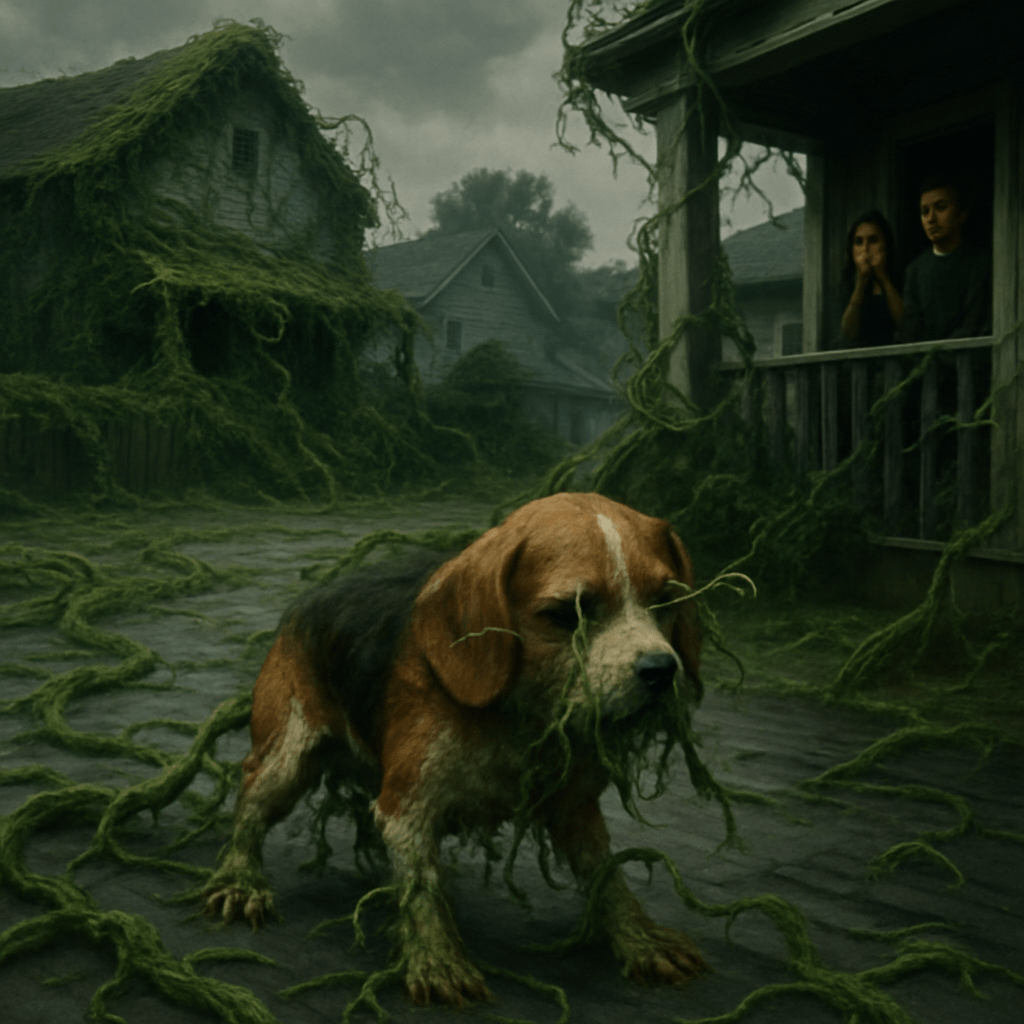
    Sadie stood in the middle of the hall, unmoving. Thick green vines writhed out of her eyes, her mouth, even her legs. Her soft brown coat was matted with sap and tendrils. Her tail had fused with the floor.

    Gregory came running, his breath frozen in his chest. Cracks spread across the walls. Vines burst through their baseboards and windows, and across the street, they saw them too. The entire neighborhood was being devoured.

    By dawn, the whole block was wrapped in green. Houses, fences, playgrounds, even the cars… gone beneath thick carpets of lush, predatory growth.

    By the time Tim finally identified what the plant was, or what it resembled, it was far too late. The species didn’t exist in any known botany records. Some kind of parasitic hybrid, it used organic matter, any organic matter, as fertilizer.

    Even now, the vines remain.

    No pets are allowed in that neighborhood anymore. No children play in the yards. People speak in low voices about what happened. About the dogs and cats that vanished. About the houses that now stand silent, leafy mounds in the distance.

    Some believe the plant still grows in other places. Quietly, feeding. Waiting.

    Disclaimer: This story was written with the assistance of AI technology to enhance its clarity and readability. However, all ideas and narrative content are original and owned by me, the creator. No part of this story, or any other content on this blog, may be reproduced, copied, or used in any form without my explicit permission.

  • A Walk to Die For

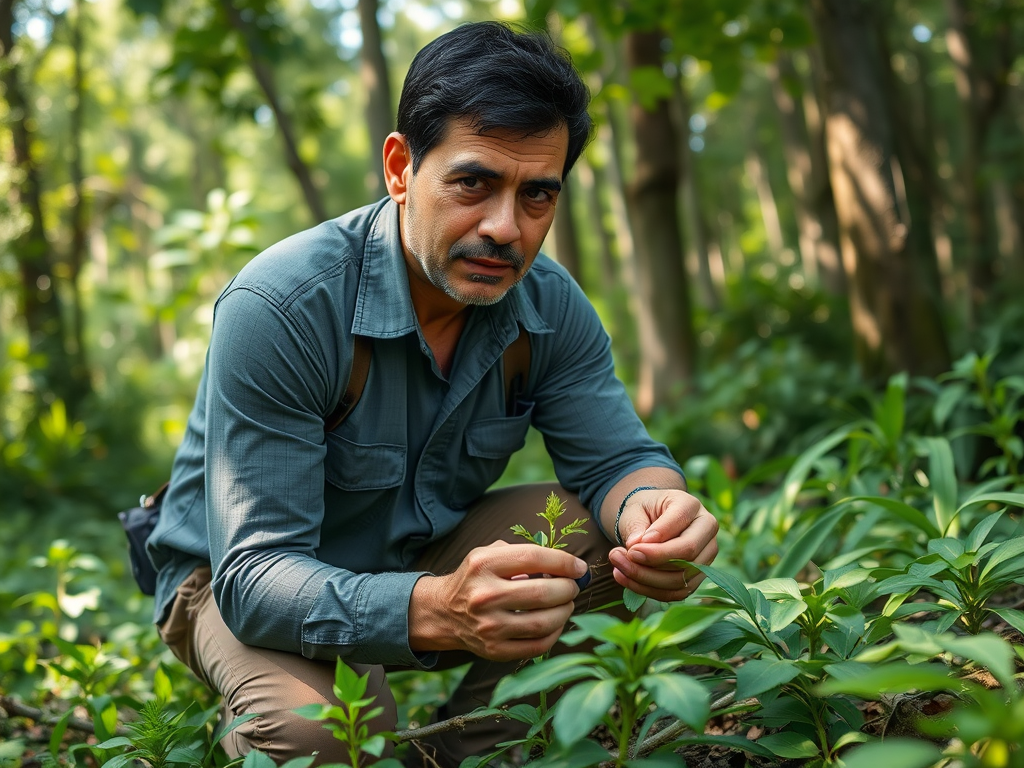
    It was a hot, sticky afternoon in the small village of Kampung Duyoh, just southwest of Borneo. Dr. Gary King was wrapping up his last day of research. He’d spent weeks exploring the village and the nearby forest, where pitcher plants carpeted the ground. The locals, who harvested these plants for food, were eager to guide him. But by late afternoon, Dr. King found himself alone and far off the beaten path.

    He had been collecting samples under the relentless sun for hours when he decided to stray from the trail in search of shade. Distracted and tired, he wandered deeper into the forest. When he finally looked up, he realized he was surrounded by dense growth—trees that seemed to have no trunks, or perhaps trunks completely covered in massive pitcher plants. He marveled at their size, gazing upwards, ignoring the strange wriggling at the base of the plants.

    When he looked down, he noticed what appeared to be animal entrails. Curious, he followed the grisly trail toward the enormous, plant-covered trees. There, he saw what might have been a sun bear, a gibbon, or perhaps a proboscis monkey—struggling, but slowly being consumed by the overgrown brush. As he edged closer to snap a photo, a large puff of spores erupted from the top of one of the trees, raining down over him and his gear.

    Repulsed and alarmed, Dr. King grabbed a specimen jar and collected one of the spore-covered plants from a nearby tree that wasn’t busy devouring an animal. He quickly gathered his belongings and fled back to the village. There, he washed the spore dust off in the river before returning to his hut. He carefully labeled all his specimens, except for the mysterious new plant, which he marked as “Specimen X.” He packed everything away for his flight back to North Carolina.

    That night, he joined the villagers for food and drink, listening to their stories about forest monsters—myths of mystical plants that hunted humans, and tales of lost princesses rescued by valiant knights. The next morning, Dr. King felt off: tired, hungry, and irritable. He blamed it on the food and a late night. After a grueling 30-hour flight, he finally landed in Wilmington, NC, exhausted. He stashed his specimens, showered, and collapsed into bed.

    The following day, despite feeling ill, Dr. King ventured into the forest near his home to collect Sarracenia, the native pitcher plant. He was eager to attempt crossbreeding the Southeast Asian Nepenthes with the local Sarracenia, hoping a recent mutation he’d discovered would allow them to hybridize. He brought the unknown specimen from Borneo and planted it at the edge of a stream to observe whether it could survive in the humid North Carolina climate.

    To his surprise, when he returned a week later, the plant had not only survived—it had flourished, spreading along the bank and climbing several trees. As he photographed the thriving plants, he wandered absentmindedly, unaware that he was walking into the path of a black bear. With his back turned, the bear attacked. As Gary screamed, only a puff of spores escaped his mouth. The bear devoured him. Where his blood stained the ground, the spores quickly took root, and bizarre plants sprouted, erasing any evidence he had ever been there.

    Years passed. The alien plant continued to spread, overtaking trees and claiming the occasional hiker—or their unwitting dog. Some victims were devoured; others, infected by spores, left the forest as carriers, spreading the contagion far beyond the woods.

  • What’s All That Buzzing About?

    Sharon was out front watering her hydrangeas. It was a hot summer morning, and she didn’t want the midday sun to scorch her prize-winning garden. As she wandered around, pruning foliage and squatting to clean up her clippings, a loud buzzing caught her attention. Looking up through her sunglasses, she saw the largest hornet she’d ever encountered. Instinctively, she screeched, dropped her clippings, and fled inside, slamming the glass door behind her.

    Inside, Sharon watched as the hornet repeatedly smashed against the glass. She let out a long, shaky exhale and tried to steady herself. Reminding herself that she was a thousand times bigger than the hornet—and that it was trapped outside—she attempted to calm down. Still, she slid up to the door and locked it, as if the hornet might somehow figure out the doorknob.

    Sharon had always feared being swarmed by stinging pests, ever since seeing the movie My Girl, where Macaulay Culkin’s character is stung to death by bees. Never having been stung herself, her fear was amplified by the unknown.

    She stood at the window, staring at her unfinished gardening and the hornet still battering the glass. She decided to wait for her husband, who would be home for lunch soon, and ask him to take care of the pest.

    When he arrived, he immediately noticed a nest above the garage. Seeing Sharon still shaken, he worked to calm her down before mentioning the small nest he’d found. Since the hornet was gone and the nest was minor, they searched online and decided not to disturb it. Hornets, after all, eat mosquitoes and other garden pests. As long as Sharon avoided the hive and did her gardening at dusk instead of in the morning, they reasoned, the hornets shouldn’t be a problem. Sharon agreed, appreciating the idea of organic pest control.

    For a couple of weeks, things were fine. But over time, her husband noticed the hive was growing—now nearly the size of a basketball. He took a few photos, curious to see how large it would get.

    One afternoon, he came home to find Sharon at the sink, washing her arm, tears welling in her eyes. “I got stung by the biggest bee I’ve ever seen,” she said, showing him a stinger the size of a rose thorn still embedded in her arm, the skin around it angry and red. He fetched tweezers, removed the stinger, and helped clean and bandage the wound.

    Sharon explained she’d been weeding near the air conditioner when she noticed a small hive above the kitchen window. Just then, their dog Tessi jumped up on the house, causing a vibration that sent a huge hornet flying out. Sharon instinctively shielded her face, and the hornet stung her arm. She dropped everything and ran inside.

    Her husband checked the hive above the kitchen window and was stunned—it was even bigger than the one above the garage. Realizing the problem was escalating, they decided to call pest control.

    The next morning, Sharon called several local pest control companies, but appointments were booked out for weeks or even months. Meanwhile, the swelling in her arm worsened, radiating heat through the bandage. She waited for her husband to get home before removing it, and together they saw the wound had become swollen and possibly infected. He advised her to wash it gently and redressed it.

    That night, Sharon couldn’t resist squeezing the swollen area in the shower; a small amount of pus came out. Later, as she stood in the bedroom, her husband’s concern briefly turned to passion, but afterward, he insisted on treating her wound with antibiotic ointment and anti-itch cream.

    The next morning, Sharon managed to book a pest control appointment, but it was still two weeks away. The hives continued to grow at an alarming rate, wrapping around the house. Sharon could no longer let the dog out safely, resorting to daily trips to the park.

    When the pest control technician finally arrived, he was so shocked by the size of the nests that he refused to handle the job alone, promising to send a team. Sharon, terrified, drove to her husband’s office to tell him what had happened. He reassured her, and they decided to spend the evening out before returning home.

    Upon their return, the hives had engulfed much of the house. Her husband bravely cleared a path for Sharon to park in the garage, then distracted the hornets so she could get inside safely. Once inside, he called the pest control office, only to learn it would take at least another week to assemble a team for the job.

    That night, Sharon’s arm worsened, the swelling spreading and the skin growing hot and red, dotted with tiny pinpricks as if she’d been stung a hundred times. In tears, she agreed to go to the emergency room in the morning.

    The next morning, her husband awoke to an ominous buzzing. Looking over, he found Sharon’s body covered in hornets, their numbers so thick they seemed to replace her skin. The dog, too, was being swarmed. As he screamed and leapt from bed, Sharon slowly stood, her voice eerily calm: “It’s alright, darling. They’re our family. They’ve come home to take care of us.”

    Looking outside, he saw nothing but darkness—the hive had consumed the house, turning Sharon into their queen, swarming the dog, and now, coming for him.

  • Soul-Sucking Nightmare

    Tess wandered her backyard as she did every bright, sunny morning. Birds chirped as she filled the fairy feeder for their breakfast, her voice carrying an old childhood song as she watered and pruned her plants. On the surface, today was like any other, she was happy, yet beneath that happiness, she felt her energy draining away. Some days were worse than others, but today the heaviness was overwhelming. It was as if a creature clung to her back, sucking out her light and life.

    Tess tried to push through, but the weight drove her back inside. She resigned herself to watching the beautiful songbirds from her window, another day spent trapped indoors. Her hands flew across her keyboard, working, while her mind spun wondrous tales of adventures she’d never taken outside her own imagination.

    But today was special. Tess needed to muster the energy to finish her work and prepare dinner for her beloved Gregory, it was his birthday, and she was determined to make it joyful. Her fingers danced across the keyboard, finishing her tasks in record time. She glanced at the clock: 3:59 p.m. Gregory would be home by five, giving her just enough time to prepare dinner and finish the German chocolate cake she’d started that morning, his favorite, made from scratch.

    Upstairs, Tess wrapped his gift: a pair of high-tech sunglasses she’d found at a pop-up stand. The salesperson claimed they used the latest wide-spectrum light-blocking technology and were so new that only twenty pairs existed. Since Gregory had everything he wanted and had recently broken his old sunglasses on a trip to Africa, Tess hoped this unique gift would be perfect. She considered trying them on herself, curious about the technology, but decided to let Gregory have the first look.

    She tied a neat ribbon around the box, tucked it into her apron pocket, and hurried downstairs to greet him. At 4:59 p.m., she saw his car rounding the corner. The garage door opened, and Tess’s smile grew, though the heaviness still clung to her. She straightened her apron and waited.

    Gregory opened the door to find Tess waiting with open arms and a radiant smile. He swept her up in a hug. “Hello, beautiful! I’ve missed you so much,” he exclaimed, noticing the cake on the table. “Is that my favorite cake? What’s the occasion?”

    Tess twirled out of his arms, singing, “Happy birthday to you, my sweet Gregory! It’s all for you.” Gregory laughed and kissed her nose.

    Without another word, Tess pulled the wrapped gift from her apron. “For you, my prince of men,” she said, presenting it with both hands. Gregory grinned, kissed her, and carefully unwrapped the gift, he always saved the paper to reuse for Tess’s Christmas presents. When he saw the sunglasses, he let out a delighted squeal. “Sunglasses! Yes!”

    Tess explained how special and rare they were, boasting about the wide-spectrum light-blocking technology. Gregory was excited but skeptical; most sunglasses didn’t fit over his prescription glasses. But to his surprise, these fit perfectly. Without looking at Tess, he stepped outside to test them, marveling at the vivid colors and clarity. “You have to try these!” he called.

    Tess followed, moving slowly, drained and weak. Gregory spun around to hand her the glasses—but what he saw made his blood run cold. Tess stood by her raised flower beds, clutching them for support, clearly struggling. Clinging to her back was a creature, reptilian in form, but with tentacles instead of a head and tail. One tentacle pierced the base of her skull, another her spine. It looked like an alien leech, siphoning her very life.

    Gregory gasped and ripped off the glasses. Instantly, the creature vanished, there was nothing on Tess’s back. Shaken, he stared at the glasses, unsure if he’d imagined it. Tess noticed his distress and asked what was wrong, but he was too stunned to answer. He simply took her hand and led her inside, setting the sunglasses on the table and thanking her again for the thoughtful gift.

    He excused himself to clean up for dinner, while Tess returned to her preparations, unaware of the nightmare Gregory had glimpsed through the lenses of her gift.

  • Sometimes they mean to

    Summer was in full swing, the long day nearing its end, and Claire was in a hurry to get home. She had a date with her favorite show, Gilded Ages, and after waiting nearly two years for the new season, she wasn’t about to miss a minute. The call center closed at 8 p.m., her show started at 9, and she was determined to be out the door the moment the clock struck closing time.

    But, of course, the last call of the evening was from a lonely old woman whose only reason for calling seemed to be the need to hear another human’s voice. As Claire gently hinted that it was time to wrap up, the woman grew impatient, her tone sharp. She demanded a technician be sent to her house that very evening to repair her vacuum.

    Claire glanced at the woman’s address and realized it was on her route home. Eager to end the call, she scheduled an after-hours appointment, explaining there would be a premium charge. The old woman grumbled but agreed. Claire jotted down the address and rushed out, glancing at her watch: 8:05. With only a 20-minute drive ahead, she figured she could fix the vacuum and still make it home before the opening credits rolled.

    Luck was on her side, the streets were empty, and every light turned green as she sped across town. She arrived at the woman’s house by 8:20. With just a quick fix ahead, she was confident she’d be home in time.

    As Claire approached the door, it swung open. The old woman glared at her and barked, “It’s about damn time you got here. If you think I’m paying for the time you spent on the phone and this appointment, you’re dead wrong.”

    Claire forced a smile. “No worries, ma’am. You’ll only be charged for the time I spend fixing your machine.”

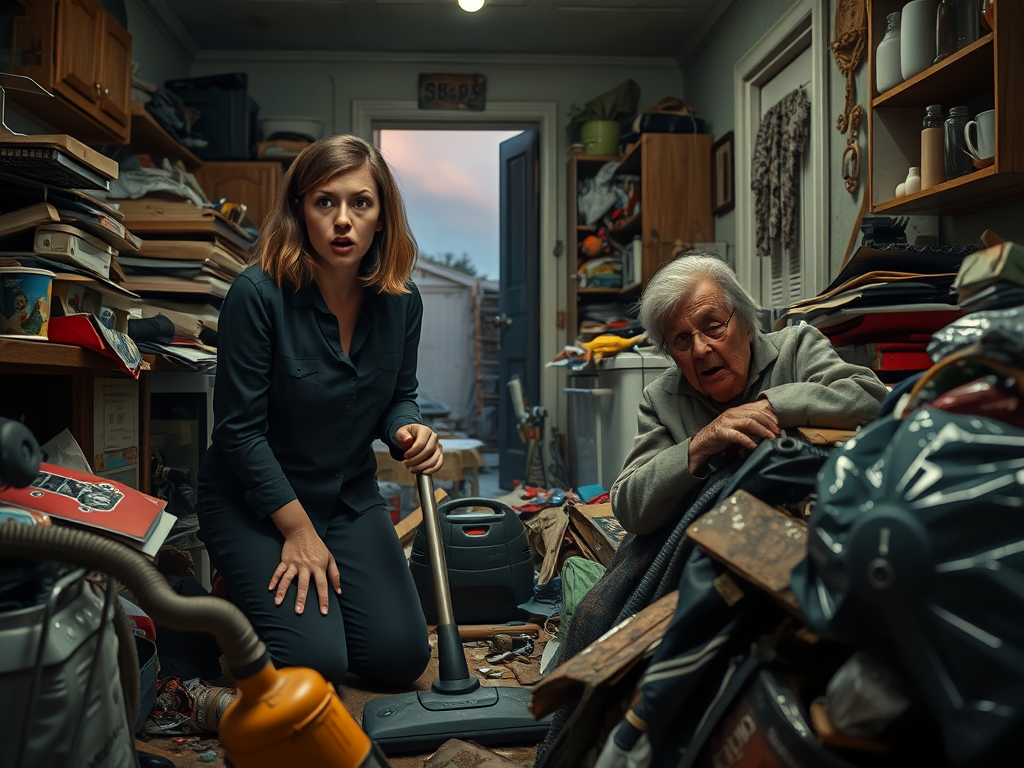
    The woman kicked open the door, and Claire slipped inside. The house was a disaster. It looked as if it hadn’t been cleaned, let alone vacuumed, in decades. Claire asked where the vacuum was, and the woman pointed across the room with a trembling, nubby hand. The vacuum sat in the kitchen, the canister lying on the floor beside it.

    Navigating a narrow path through the hoarded clutter, Claire entered the kitchen. The stench was overwhelming; she breathed through her mouth to cope. She knelt to grab the vacuum cleaner head when, suddenly, a loud crash echoed behind her. She spun around to see an avalanche of junk bury the old woman in the hallway.

    Claire gasped, hearing the muffled cries for help. Frozen in disbelief, she looked down at her watch, then back at the pile. There was no way she could dig the woman out alone. She scanned the room for something to use as a shovel, but then she noticed it—a back door, wide open, leading outside.

    She looked at her watch again: 8:59 p.m.

    Claire made it home just in time for the opening scenes and the recap from last season. She kicked her feet up on the couch, petted her sweet dog’s head, and munched on popcorn, humming along to the theme music.

    Disclosure:
    All content on this blog is originally written by me. I occasionally use artificial intelligence (AI), specifically Perplexity AI, to help revise, edit, or enhance my writing for clarity and readability. Every post reflects my own ideas, voice, and perspective. If you have any questions about my writing process or how I use AI tools, please feel free to ask in the comments.